About Foreign Trade
In the interconnected global economy, self-sufficiency is elusive for any nation in producing all necessary goods and services. Countries depend on each other, importing goods that are scarce domestically.
Simultaneously, they seize opportunities to export surplus goods, creating a symbiotic relationship. This interdependence in international trade fosters collaboration, economic growth, and a dynamic exchange of resources on a global scale.
In the 21st century, the global landscape is shaped by the United States, European Union, and China as the leading markets. Foreign trade significantly contributes to a country’s GDP in most nations. In ancient times, trade routes such as Uttarapatha, Amber Road, salt road, and Silk Road facilitated international trade, connecting countries and fostering economic exchanges. Today, these historical routes echo the enduring importance of global commerce and interconnected markets in shaping the world economy.
Benefits of Foreign Trade Courses:
- Exploring diverse career prospects, this field opens avenues in banking, trade, commerce, and accounts. Offering a pathway to professional qualifications in foreign trade, it establishes a solid foundation in international business.
- Opportunities extend to roles in export houses, where individuals contribute to expanding overseas sales and exploring new business hubs.
- Alternatively, a career as a marketing executive awaits, involving strategic planning informed by comprehensive marketing research.
- The field provides a dynamic platform for individuals to thrive in various domains of the global business landscape.
Want Help with Admission
Leave us your details and we will contact you soon
Courses & Eligibility
Various undergraduate (UG) and postgraduate (PG) courses, along with diploma programs, cater to the field of foreign trade. These educational offerings serve as a comprehensive guide for students, clarifying concepts related to international trade between nations. Below are some of the widely recognized and popular courses in this domain
Diploma Courses:
- Diploma in International Trade
- Advanced Diploma in International Business
- Diploma in Foreign Trade Management
- Advance Diploma in Foreign Trade
Eligibility Criteria:
To enroll in undergraduate courses, a higher secondary or 12th class completion is required (Courses After 12th). For master’s programs, applicants should possess a bachelor’s degree in the relevant field. Doctoral courses (M.Phil) necessitate a master’s degree in the related field for eligibility.
Admission
Admission to the Indian Institute of Management (IIM) is granted based on the CAT 2023 national-level examination. Other institutions consider results from exams like XAT 2020, CAT, MAT 2023, GMAT 2023, etc., for admissions.
In addition to entrance tests, certain institutions admit students based on Aptitude Tests, Group Discussions, and personal interviews. Notable MBA entrance examinations include:
- CAT (Common Admission Test)
- Management Aptitude Test (MAT)
- Xavier Aptitude Test (XAT)
- Graduate Management Admission Test (GMAT)
- Common Management Admission Test
- Indian Institute of Foreign Trade
- CUSAT Common Admission Test
Career in Foreign Trade
“The demand for Foreign Trade professionals is rapidly expanding, opening up abundant career opportunities. Manufacturing companies, banks, financial institutions, and government agencies engaged in international trade actively seek individuals with expertise in Foreign Trade. The scope for Foreign Trade professionals extends not only within India but also internationally.
Numerous companies hire and deploy Foreign Trade professionals for international projects. Roles such as Foreign Trade Manager involve analyzing technical data in global business transactions and comprehending international trade policies and agreements.”
MBA Foreign Trade: Salary Trends
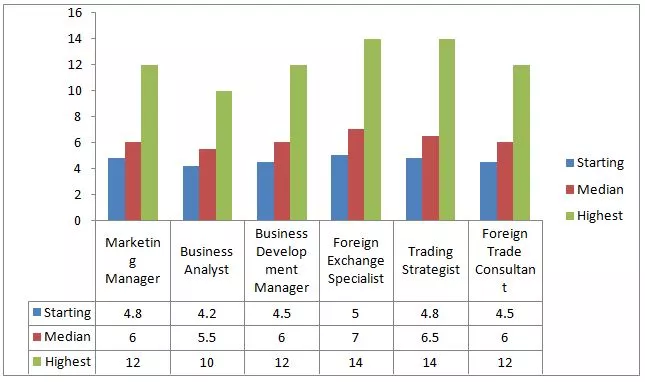
Graduates from prestigious B-schools with an MBA in Foreign Trade typically command an average salary ranging from 6 to 12 lakhs. The salary trend is influenced by the specific job profiles individuals occupy and varies based on the employing company’s compensation structure.
Following graph shows salary trend according to job profile-